Comments on Hunter
The boat is going to take a little getting used to, as I haven't paddled anything this narrow before, but she sure is fast! It is really a lot of fun in the water, and almost seemed more stable in chop and waves than on flat water. Very responsive to leans and edging. It is very maneuverable with the skeg up, and tracks like a train with the skeg down. Exaclty what I was hoping for.
Bruce Webb
Den Hunter jag började bygga i oktober blev klar lagom till det fina vårvädret. Utöver att jag tycker den är obeskrivligt vacker, upplever jag den som lättdriven och totalt okänslig för vind! Det känns befriande med det låga däcket, benutrymmet räcker väl till och den försänkta sargen ger bra stöd för knäna. Kajaken har också visat sig ha tillräcklig lastkapacitet för mina dagsturer i skärgården. Visst är den initialrank, men jag känner mig ändå trygg i den. Detta trots att min erfarenhet begränsar sig till en säsong i Kavat. Jag väljer dock grunda vatten tills vidare, eftersom jag inte behärskar roll ännu.
Rune Eurenius
I have to say, I thought it was going to look very sleek, but it has an even more elegant shape than I was hoping for. The higher deck, as per you plans, to my eye, did not compromise the aesthetic at all. It looks so good, on and off the water. Really, this must be one of the most attractive looking designs available ... Thanks Bjorn, for sharing your design with me, it was a real pleasure to build. It is everything I had hoped for, and more.
Etienne Muller
Bjorn, Thanks so much for the very detailed and interesting "tour" of your Greenland design. The design is so well balanced, and is a must for me when ever you have the plans ready for sale. I've been researching the various Greenland types, but yours is by far the most beautiful example I've seen with it's low,sleek, and subtle flair. You have managed to bring out the best of this type.
Tom Yost
What a fine looking AND handling kayak you've designed!! And fast, fast, fast...........After a couple of hours of roll practice (or trying and missing!), I was tired but still able to paddle and hold a 4.5 to 5 mph pace for an hour or so as as the sun set.
Tripp Stanley
eg ville bare si at jeg er utrolig fornøyd med Hunteren. Jeg har nå padlet med den i omtrent 40 km. I flatvann, vind, og litt større bølger.
Det er en utrolig rask båt, passer veldig bra for dagstur, og har bra stabilitet i bølger.
Nico Vertriest
I enjoy more and more Marbom, my Hunter […] she is almost perfect.
Nice to play and roll and faster than most kayaks around.
Guido Galbariggi
Hunter
Latest updated Monday, February 5, 2024, 18 comments
Images | Particulars | More about | Background and history
Plans, Hunter - 130 EUR
Purchase
Hunter, designed in 2002, is a very long, narrow, low volume kayak, loosely based on the hunting kayaks of southeastern Greenland. It is fast and responsive, tracks well with good balance, and is very easy to roll brace.
Most European or American-built "Greenland kayaks" have been modeled on west coast designs. Many can trace their origin back to the kayak Ken Taylor brought back to Scotland in 1959. By that time the west coast kayaks were influenced – for good and bad – by the outside world. The east coast had been more isolated during what is sometimes referred to as "the little ice age" and when the eastern hunting kayaks were rediscovered, their forgotten qualities had a profound influence on the development of the modern Greenland kayak – the rake of the stems is greater, the sheer flatter, the flare of the sides has increased and the deadrise in the bottom is almost gone. They were faster, particularly against a headwind, more maneuverable, and less affected by the wind than the west coast designs.
Hunter is not intended to be a replica. The construction method is wood-strip instead of skin-on-frame, the foredeck is 2" higher (I guess few paddlers would be happy with the 7" under-deck height of the original!), the bottom is slightly wider (since westerners are taller in general than the Inuit of 19th century, the kayak would have felt much tippier without the adaptation) and the chines are slightly rounded (giving a smoother stability curve and better water flow along the hull, without sacrificing the ability to turn by leaning). Despite these changes, I have tried to keep the beautiful looks and performance characteristics of the Greenland original.
This is a narrow boat (20.5" at the sheer, 18.5" at the waterline), but it is not scary to paddle. Initially tippy but with reassuring secondary stability, even novice paddlers quickly feel at ease (I would not recommend Hunter as a first kayak though – at least not unless you have ambitions and perseverance above the ordinary). The narrow width does make it easy to edge the boat with confidence when desired. The flat sides create a smooth and predictable secondary stability without the feeling that you will suddenly get dumped into the water.
...and almost seemed more stable in chop and waves than on flat water.
Bruce Webb, North Carolina
The low aft deck permits the paddler to lean back with his head to the deck, making Greenland-style rolls and many traditional braces easy. The foredeck is also low by modern standards (9.6" at the footrest) and is intended for those practitioners of Greenland-style paddling who prefer a truly snug boat. Sitting with the knees slightly out and toes pointing slightly forwards, it is surprisingly roomy, even for large feet. Those who prefer a little more comfort might use the higher deck (10.6"), indicated by dotted lines on the plans. With its low deck, the boat is not adversely affected by the wind.
The kayak is very easy to maneuver thanks to the rockered keel, flat bottom, rounded chines, and comparatively short waterline. Leaning is a choice, not a necessity.
When the speed increases, the bow and stern waves climb the raking stems, rapidly increasing waterline length and as a consequence, hull speed and tracking. The results are the unusual double benefits of very easy maneuvering at low speed and good tracking at high speed.
What a fine-looking AND handling kayak you've designed!! And fast, fast, fast...........
Tripp Stanley
With a short waterline and a narrow hull, the wetted surface area and the frictional drag are small – not much more than a competition K1). The acceleration is impressive – a couple of strokes will bring you to maximum hull speed.
Overall, this boat is a lot of fun to paddle. With its relatively low volume, it is not intended as a multi-day touring boat - though traveling light and with a little packing discipline it will hold a surprising amount of gear. It is probably better suited as a day-tripping boat, with the high touring speed letting you explore a lot of shorelines in a day. It is even better for practicing rolling, surfing, rock hopping, and playing in breakers off the beach.
Like the traditional boats of the Inuit, it is a versatile craft ready to take wherever you wish to go, whatever you wish to do.
Particulars
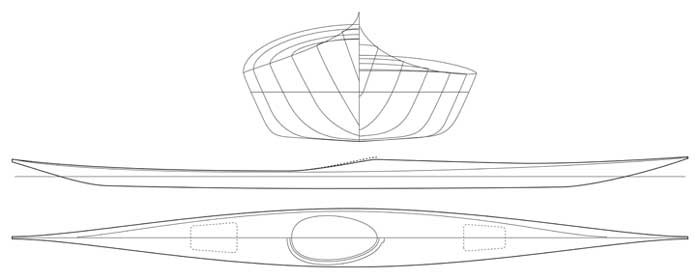
| Length¹ |
585/491 cm (overall/WL) |
| Beam |
51/47 cm (overall/WL) |
| Draft |
11 cm |
| Cockpit¹ |
78x38 cm |
| Height¹ |
24.5/15 cm (in front of/behind the cockpit) |
| Weight² |
16-21 kg |
| Displacement/volume⁶ |
125 kg/230 litre |
| Speed³ |
7.9/11.3 km/h |
| Prismatic coefficient |
0.55 |
| Wetted surface |
1.86 m² |
| Drag⁴ |
1.34/2.73 kp |
| Stability⁵ |
1/3 (initial/secondary stability) |
| Intended use |
Advanced paddling, rockhopping,etc. Touring, coastal and deep sea. Day tours and exercise. |
* These dimensions can be adapted to suit personal needs or wishes.
** Depending on type of wood, equipment, care with epoxy usage, sanding etc. etc.
*** The speed numbers are based on mathematical standard formulas (175 lb paddler + 30 lb carco weight) and corrected from the kayaks actual performance om trials, on tours and in races.
⁴ Calculated resistance in 4 and 5 knots (at nominal load capacity).
⁵ Initial stability and secondary stability on a subjective scale, where 1 is very tippy and 5 is very stable.
⁶ Displacement is kayak + paddler + load. Count off the kayak weight to get the load capacity.
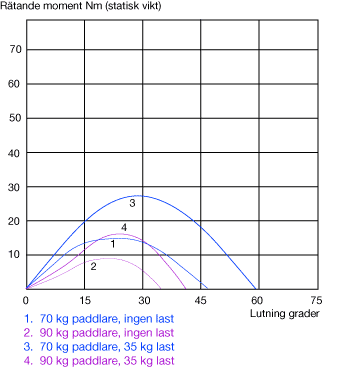
Stability
The curve shows the calculated stability with a static load, and therefore of limited use for a real paddler. The part of the curve near zero degrees indicates the initial (primary) stability – the steeper the curve, the more stable. The part of the curve left of the peak indicates end (secondary) stability – the higher and wider, the safer you feel edging the kayak. The position of the peak shows also how much the kayak can be leaned without tipping over. The part of the curve to the right of the peak with rapidly decreasing righting moment is almost impossible to take advantage of.
Plans
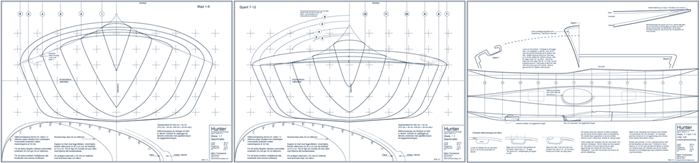
The plan sheets contain the information needed to build the kayak/canoe. Station molds, stems and construction details are full scale. For kayaks the recommended cockpit size is shown half scale with offsets for a full scale drawing and advice on altering the size. On the plans you will also find advice on how to shorten or lengthen the craft. Lines and construction drawings are in metric scale 1:10.
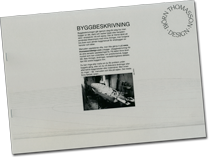 The illustrated step-by-step building manual is in Swedish only, but it is available online in English: it covers all steps in detail and will guide first-time builders through the project.
Plans, Hunter - 130 EUR
Purchase
Minimum window dimensions to get your kayak out from the workshop:
52x28cm
More about Hunter
Hunter is based on the east Greenland kayaks of the early 20th and is, like these, low, narrow, long with a straighter sheerline than the western types. My interest in Greenland started with trying a Greenland paddle and I got curious about the qualities of the Greenlandic kayaks and the possible combination benefits.
Hunter is very long (585-590 cm depending on the shape of the stems). But the waterline is comparatively short, just 491 cm. At low speeds, Hunter turns easily. I higher speeds, the bow, and stern waves climb the raked stems and the waterline length increases, adding speed potential and tracking. The narrow and short waterline means minimal wetted surface and very low friction. Acceleration is lightning fast – two or three paddle strokes to top speed.
Theoretically, the Hunter hull should have higher touring speed (low friction) but lower top speed (short WL) than fx Nomad, Najad, Njord, etc. Testing in different conditions shows the touring speed potential, but also that Hunter is very fast off the wind by surfing easily and with control.
The narrow beam also (BOA 51 cm, BWL 47 cm) means that Hunter is a tippy kayak, with relatively low initial stability. Compared to an ordinary sea kayak, Hunter will be a challenge initially. But with solid secondary stability, the risk of capsizing is surprisingly low – capsizes occur when the secondary stability is overplayed, never within the initial stability range. Thus, even beginners will find comfort and security within a couple of hours. The real bonus with low initial/high secondary stability comes in waves – a stable kayak is a lot more affected by waves; Hunter moves vertically in waves, instead of rolling violently from side to side, as would a more stable kayak (the reason is that stability is just the kayak wanting to stay parallel to the surface). Hunter is furthermore more stable in speed and surfing when it sinks slightly down in its own wave system.
The planking is straight between chine and sheer and there is no rounding over at the sheer. The advantage is that the secondary stability is not compromised – high brace and balance brace are easy to do. The usual disadvantage with a sharp edge at the sheer is that the paddle stroke can't be as close to the center as with a generous rounding, but with Hunter's less beam and low sheer this is not an issue – even with a competitive high stroke technique, the paddle is as close to the centerline as in most surfskis. There is simply no reason to sacrifice any secondary stability.
In speed, with bow and stern wave climbing the stems, whether by forceful paddling or surf, the kayak gains stability by sinking slightly down in its own wave system – an indication of how hydrodynamically sound the old Greenland hull is.
Hunter is very maneuverable. The flat bottom, the slightly rounded chines, and the short waterline mean that it turns easily and reacts directly to leaning sideways or front-back. It is, together with Black pearl, Njord, and Frej my most maneuverable kayak.
Hunter is a low kayak. At the footrest, just 245 mm. It may seem low but it is normally comfortable for shoe sizes up to 43. For more space, there is a higher deck line (260 mm at the footrest) indicated on the plans. The Inuits of
On the prototype I tried a couple of new ideas that found their way into the building manual: a recessed cockpit rim – low, strong, elegant and easy constructed – and deck hardware after an idea of Gerald Maroske – also recessed and quick and efficient to construct.
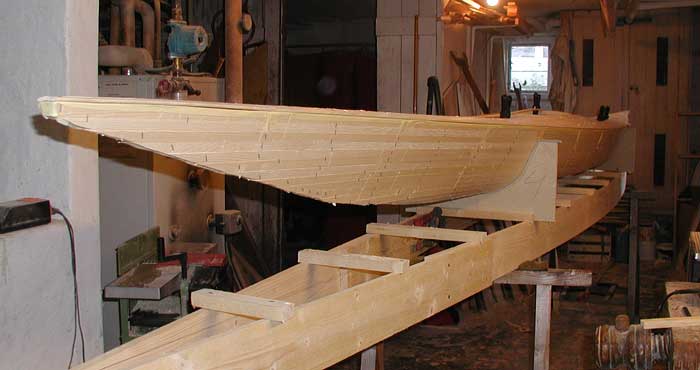
The hull stripped...
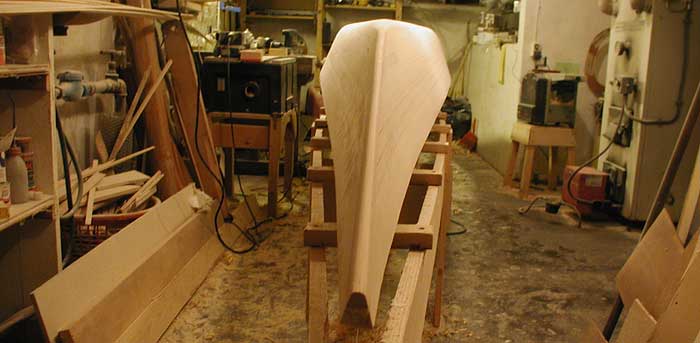
Sanded – outer stem of maple
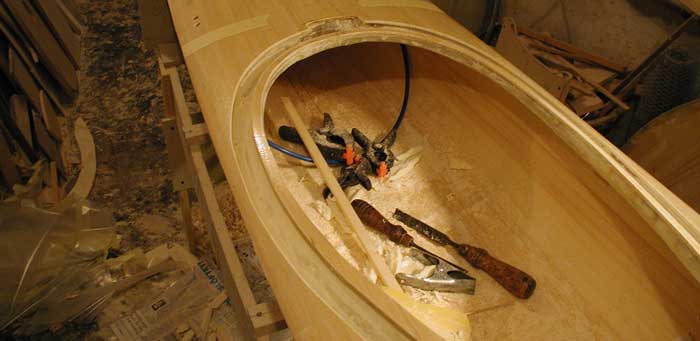
Recessed rim
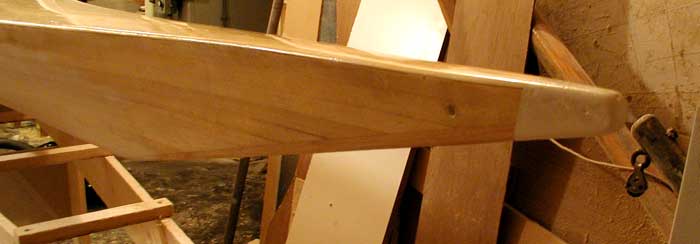
Stems with bone-imitating epoxy, microfiber, and white pigment
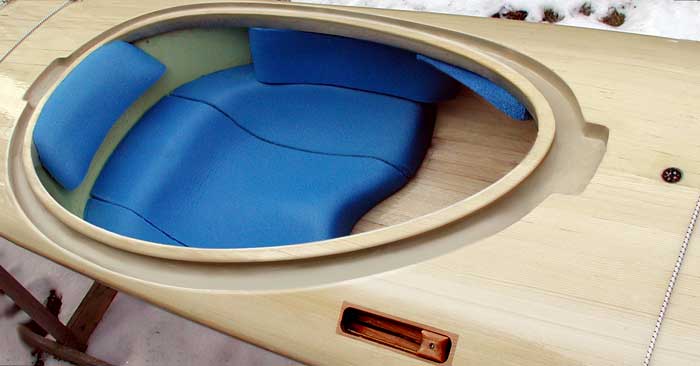
The most comfortable cockpit interior I have built – foam plus camping mat. In three parts to fit together inside the cockpit and to drain water from the set. Note also the laminated-in miniature compass – handy when you forget to bring the compass.
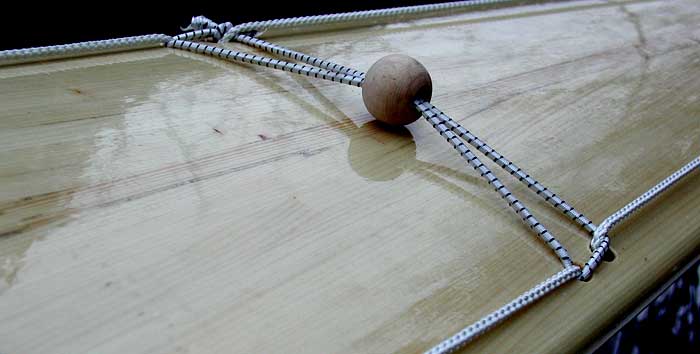
Deck hardware – the Maroske line tubes. The wooden ball is to simplify storing the paddle.
To chose Hunter I believe you should have some paddling experience (or lots of ambitions and patience), and be interested in fast touring as well as surfing, rock-hopping and in developing skills in general.
Hunter – background and history
The East Greenland kayak found its modern shape later than the west Greenland types, but around 1900 it began to influence the kayak culture around the coast. Compared to the older types it was narrower, longer, with longer stems and straighter sheerline. With a flatter bottom and more flared sides it was faster, especially on the wind, and maneuvered better. Initial stability was lower, but the secondary better. A more demanding kayak but with greater potential.
When English manufacturers in the 60s again got interested in Greenland kayaks, it was the western type that was in focus, primarily the famous Illorsuit from the coast north of Disco Bay. This became the model for most brit-boats since then; Anas Acuta, Icefloe, Nordkapp, etc.
I chose to focus on the eastern type. Through references in books, I got curious about the qualities: they were rumored to be fast (especially on the wind), and easily maneuvered. When they were rediscovered, after the cold period that isolated East Greenland for a couple of hundred years, they influenced the development of modern kayaks all around the coast, but mainly in the kayaks for rolling competitions.
My Hunter, from 2002, is no historical replica. For a start, choosing wood strip is a major deviation. But also the deck height – no westerner could possibly squeeze in under an 18 cm high foredeck! I needed at least 5 cm more room. And since westerners, in general, are taller than 20-century inuits I added a few cm beam for stability.
The name Hunter was chosen since those 19-century east Greenland kayaks were probably the most efficient hunting kayaks ever built.


