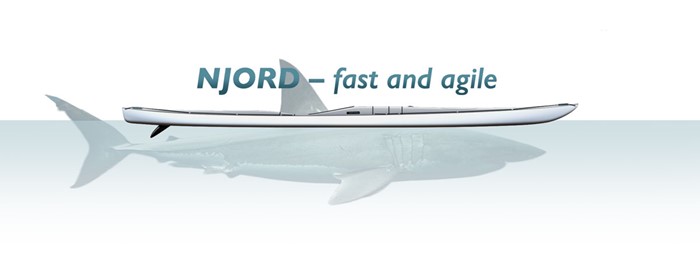
Njord
Senast uppdaterad den 6 oktober 2026, 146 kommentarer
Bilder | Specifikationer | Mer om | Bakgrund och historia
Ritningssats, Njord - 2 100 SEK
Beställ
Snabbtitt på prestanda

manöverbarhet |
kursstabilitet |
marschfart |
toppfart |

initialstabilitet |
slutstabilitet |
lastkapacitet |
Rekommenderad utrustning: justerbar skädda roder skott/luckor
Njord är en hybrid. Jag har försökt kombinera Nomads långfärdegenskaper med Black Pearls lekfullhet. Mera exakt har jag strävat efter fartresurser som Nomad och rollkvaliteer som Black Pearl. Några kompromisser har naturligtvis varit oundvikliga – Njord lastar inte lika mycket som Nomad och manövrerar inte riktigt lika lätt som Black Pearl.
Njord har som en följd av detta en något kluven "personlighet" – på samma gång effektiv långfärdsmaskin för alla förhållanden och ändamål, och följsam lek- och rollkajak.
Nyckelorden är:
- snabb – hög marschfart och stor aktionsradie med måttlig arbetsinsats,
- trygg – minimalt vindfång och lugna lättparerade rörelser som innebär att man sitter torrt, lugnt och avspänt även i grov sjö och hård vind,
- följsam – Njord gör det du vill oavsett om det är ambitiösa dygnsdistanser med fullastad kajak, lek surf eller rockhopping, eller en bra placering i en rolltävling...
 Njord har vid två tillfällen paddlats runt svenska kusten enligt reglerna för HBB (Havspaddlarnas Blå Band).
Bengt Carlsson 2010, med HBB-nummer 130, totalt 2532 km på 74 dagar.
Ove Sigvardsson 2014, med HBB-nummer 156, totalt 2333 km på 43 dagar.
Byggrapporter och bilder från mitt Njordbygge – och en turberättelse med min första test av Njord
Bilder från Tomi Biloglavs Njordbygge (flera hundra kommenterade bilder på Flickr!)
En riktigt originell Njord är denna tredelade, som Danne byggt!
Ytterligare en byggdagbok, https://www.facebook.com/fridstrom.kajak2
Även Niklas Gunnarsson har en välgjord byggblogg (en Njord i Paulownia)
The Njord from your design is an extraordinarily elegant and aesthetic kayak. It impresses not only with its lines but also with its excellent performance and seaworthiness. The initially unusual lower initial stability compared to my Frej was no longer an issue after a short time—the joy of paddling the Njord has long made me forget this first impression. The hull and deck were made from Western Red Cedar (WRC) and refined with design strips made of mahogany and aspen. During construction, we placed special emphasis on handiness, low weight, and an appealing look. The Njord, shortened to five meters, weighs just 14.8 kg, accelerates excellently, allows for a high cruising speed with minimal effort, and remains safe and easy to handle even in more challenging conditions.
Gerald Schlemmer
Njorden blev snabbt min favoritkajak sen den sjösattes i februari. Den väger bara 17 kg och är därför lätt att själv slänga upp på takräcket. Den rymmer både tält, liggunderlag, sovsäck, mat och annat för flerdagsturer till havs. Den är snabb och fantastisk i grov sjö och framför allt - den är lättrollad, när man väl behärskar rollarna. Den kanske inte är lika lätt att lära in eskimåsvängen på som med en Black Pearl.
En oslagbar kombination är därför att ha en Black Pearl för kortare turer, motionspaddling och rollträning och Njorden för de längre turerna. Varför skall man bara ha en kajak? Man har ju olika skidor för olika åkning.
En detalj - Njordens inbyggda kompass är ovärderlig. När man minst anar det uppstår plötsligt ett behov av kompass. Då känns det skönt att den finns där.
Njorden är verkligen trivsam och bekväm. Inte mycket att fundera över - välj den!
Björn Welin
- Sittställningen är grym, helt anpassad för mig och kajaken känns som en förlängning av mig själv. jag är 183 cm lång och väger ca 75 kg.
- Njord är snabb. Paddlar i 9-9,5 km/h distansfart men kan skrämma upp den i runt 12 km/h om man tar i (vingpaddel). För touring kör jag grönlandsåran och håller god fart även här.
- Har även en Frej 534 som är en fantastisk kajak, mycket mer lekfull än Njord men inte alls lika snabb. Därmed inte sagt att Njord är tråkig men den passar klart bättre för motion, långfärd. Samt självklart roll men här är även Frej grym. Stora vågor, mycket vind så väljer jag Frej för surf och lek, annars Njord. Sitter lika bra i båda. Paddelisättet är bättre i Njord som är smalare/lägre. Paddlar även surfski (Nelo 540) och farten i Njord ligger inte långt ifrån nelon vid längre distanser.
- Linjerna är de finaste jag sett på en havskajak och de lirar perfekt med funktionen. Båten både ser snabb ut och är det. Dessutom sitter man som en kung.
Jonas Nilsson
...och en första kommentar till ett av Dan Caouettes Njordbyggen:
Dear Dan, Nereida is just INCREDIBLE We have been paddling together an is FAST, ELEGANT...and almost sexy!!
I still don´t have photos on the sea, but believe: everybody turns and stare at her.
I can stand about 5-6 Knots, she surf waves, is stable...the perfect kayak??
I am a HAPPY MAN
Thank you Dan!!!!!!!!!!!
Gonzalo Martínez-Monche Zaragoza (kajaken byggd av Dan Caouette)
Specifikationer
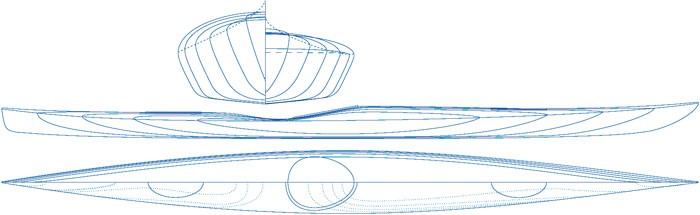
Njord har tämligen skarpa slag midskepps för att svänga bra när kajaken lutas. De östgrönländska kajakernas flacka V-botten och utfallande fribord, balanserar den relativt låga initialstabiliteten med en hög slutstyvhet. Slagen rundas mot ändskeppen för ge mjuk, torr gång med lättparerade rörelser i krabb sjö. Ett relativt kraftigt språng ger manöverbarhet och placerar paddlaren något djupare i vattnet, vilket dels ökar stabiliteten och dels sänker friborden midskepps för en bekvämare paddelmotorik och minskat vindfång. Ändskeppen har korta överhäng och stor volym ovanför vattenlinjen för att ge hög toppfart och för att åstadkomma reservdeplacement utan att stävarna behöver vara höga. Det låga däcket ger bra kajakkontroll och minskar vindmotståndet (men för paddlare med stora fötter eller anlag för klaustrofobi finns ett två cm högre däck inritat som alternativ på ritningen).
Njord i siffror
| Längd¹ |
559/534 cm (total/kvl) |
| Bredd |
51/50 cm (total/kvl) |
| Djupgående |
11 cm |
| Sittbrunn¹ |
50x38 cm |
| Innerhöjd¹ |
26/17 cm (framför/bakom sittbrunnen) |
| Vikt² |
15-20 kg |
| Deplacement/volym⁶ |
130 kg/304 liter |
| Fart³ |
8,6/12,3 km/h |
| Prismatisk koefficient |
0,56 |
| Våt yta |
2,03 m² |
| Släpmotstånd⁴ |
1,52/2,73 kp |
| Stabilitet⁵ |
3/4 (initial/slutstyvhet) |
| Användningsområde |
Expedition and touring, coastal and deep sea. Rolling and advanced paddling. Day tours and exercise. |
¹ Dessa mått kan lätt ändras efter egna önskemål
² Beroende på träslag, utrustning, noggrannhet med slipning, laminering etc.
³ Marschfart resp. motsvarande toppfart. Värdena är från början teoretiskt uträknade (Crouch´s formel) och justerade efterhand som jag kan göra relevanta praktiska tester.
⁴ Släpmotståndet i 4 resp. 5 knop mätt i kp vid angiven lastkapacitet.
⁵ Initialstabilitet resp. slutstabilitet – 1 är mycket rank, 5 är mycket stabil.
⁶ Deplacement är kajak + paddlare + last. Räkna bort kajakens vikt för att få lastkapaciteten.
Stabilitet
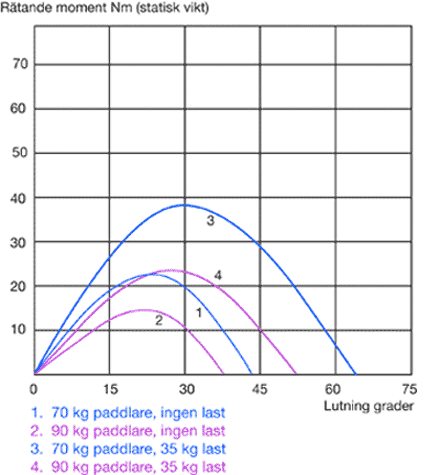
Diagrammet visar beräknade stabilitetskurvor med en statisk last, och säger därför relativt lite om hur kajaken känns för en rörlig paddlare. Kurvan nära noll grader indikerar initialstyvhet (hur kajaken känns när den inte lutar) – ju brantare desto stabilare. Linjen strax till vänster om högsta punkten indikerar slutstyvheten. Ju högre och bredare toppen är desto tryggare känns kajaken att luta. Toppen visar också hur mycket kajaken kan luta utan att det känns instabilt. Kurvan till höger om toppen är svår att utnyttja – minsta misstag så slår man runt.
Om ritningar och bygge
Tre ritningsblad rymmer den information som behövs för att bygga kajaken. Spant, stävar och konstruktionsdetaljer i fullskala. Rekommenderad sittbrunn i halv skala, med anvisningar för att förstora eller förminska för den som vill. Anvisningar finns även för att förlänga eller korta kajaken, och att höja däcket för den som har större fötter än mina 43-44. Linje- och konstruktionsritning i skala 1:10. Viktiga detaljer eller idéskisser i full skala.
Till Njord går det åt ungefär 300 löpmeter ribb (20x5 mm) inklusive marginal för spill och ett och annat misstag mm, 17 meter glasfiberväv (ca 160 gr/m2 på 100 cm bredd). Epoxyåtgången är svårare att ange eftersom den till stor del beror på hur den appliceras, men ungefär 6 kg är ett rimligt riktvärde. Värdena gäller om du bygger enligt ritningen – ändrar du längd eller annat måste du såklart justera åtgången proportionellt.
Vill du skissa på färger och utrustning finns här en profilritning att ladda ner: importera till Photoshop eller skriv ut och rita/måla: Njord.
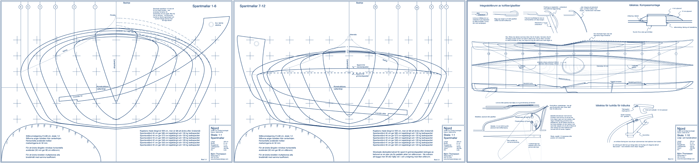
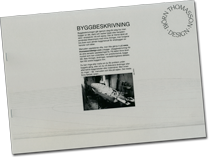 Med ritningssatsen följer en illustrerad byggmanual med 36 sidor, som går igenom alla moment – tillräckligt detaljerat för att även en helt ovan byggare skall klara av att bygga kajaken.
Ritningssats, Njord - 2 100 SEK
Beställ
Minsta fönstermått för att lyfta ut den färdiga kajaken: 52x30 cm
Mer om Njord
Maximal verkningsgrad (flest kilometer per pastaportion) har jag lagt vid 9 km/t (lång vattenlinje och en ganska hög volymkoefficient: 0,56), vilket innebär att Njord främst är en kajak för den som vill komma långt utan att råslita. Men eftersom den är smal och har liten våt yta (och därmed friktion) går den lätt även i betydligt lägre marschfart.
Njord är snabb. Paddlar i 9-9,5 km/h distansfart men kan skrämma upp den i runt 12 km/h om man tar i
Jonas Nilsson
Kursstabiliteten är aningen bättre än Nomads och för att svänga tvärt behövs lite kantning. Jag har därför sett till att slutstyvheten är mycket bra – det känns helt tryggt att kanta kajaken 30 grader utan att behöva förlita sig på lågt stöd (här är två utförliga recensioner av egenskaperna, en från USA och en från Finland).
Manöverbarheten är mycket bra – girar, sidoförflyttning, paralellförflyttning, "handbromssladdar" och liknande kan bli till spektakulära uppvisningar för den som kan hantera paddeln. Kajaken är lika lättrollad som Black Pearl, men den höga slutstyvheten innebär att t ex balance brace är ännu lättare. Det är bara att slänga sig ut i vattnet och trycka kajaken från sig så flyter man som en kork - med eller utan paddel.
... Andra halvan av rollen var inte heller svår, det ÄR en självrollande modell!
Björn Holst
Lastkapaciteten är en hel del mindre än i Nomad och kräver lite pack- och lastdisciplin för att medge veckoturer. Den som har lite friluftsvana har inga problem att lasta in vad som behövs för ett par veckor i vildmarken, medan den som är van vid höga och breda kommersiella kajaker kanske blir lite bestört vid första försöket.
Stabiliteten kan möjligen vålla lite oro initialt för den som är van vid nybörjarkajaker (se kommentar nedan). Initialstabiliteten är relativt låg medan slutstyvheten är mycket hög. Det innebär att kajaken kommer att kännas lite vickig initialt men att den i sjögång går lugnt och mjukt. För en paddlare med lite vana kommer den att kännas trygg, lätthanterad och pålitlig i besvärliga förhållanden.
Njord är för mig mycket tryggare än breda och höga kajaker (förutom att den är väldigt mycket roligare - inte helt oviktigt). Jag känner mig faktiskt direkt otrygg i de flesta köpekajakerna i alla förhållanden förutom platt vatten då de inte bara är oförutsägbara utan även saknar kontakt mellan mig och båten.
Jonas Nilsson
Njord har östgrönländsk påbrå och de relativt låga däck som detta medför. Däcket framför sittbrunnen är 4-5 cm lägre än i "normalkajaker" (men 3 cm högre än i min Black Pearl). Det innebär att sittställningen kräver lite tillvänjning, men efter några timmar känns kajaken som en välsittande sko – bra kroppskontakt utan att klämma eller trycka någonstans (förvånande för dem som är vana vid kajaker med stor volym där det krävs tryck mot fotstöd, höftstöd, knästöd, svankstöd etc för att man skall känna kontroll över kajaken). Bakom sittbrunnen är däcket så lågt att man ligger bekvämt med huvudet på akterdäck - underlättar lite svårare rollar och uppgång från balance brace mm. Med full last är Njord faktiskt ännu mer lättrollad än olastad, dels genom att kajaker flyter en aning djupare och man därför inte behöver lyfta kroppen lika högt, och dels genom att rörelseenergin hjälper till i slutfasen av rollen.
Njord kan byggas med liten sittbrunn (ca 50x39) eller stor sittbrunn med knästöd (ca 80x40) efter önskemål. På ritningen finns två stora packluckor på för- respektive akterdäck. Den som vill kan bygga Njord utan skott och luckor på traditionellt grönlandsvis, men med det låga akterdäcker blir den rätt opraktiskt att packa. På prototypen byggde jag även en "fikalucka", men den kändes både onödig och rätt oanvändbar på det låga akterdäcket. Skotten är placerade så att volymen i sittbrunnen minimeras.
 Njord har en utdragen akterlinje och går därför (i alla fall i teorin) att använda utan skädda för den som vill hålla ner vikt och mekanisk komplikation, men jag rekommenderar det inte, eftersom det medför mycket onödigt jobb med paddeln och att man måste sänka farten i sidvind för att reducera upplovningen (synd i en kajak som medger hög fart med relativt lite jobb). En justerbar skädda innebär fartvinst i allt utom motvind och stiltje. Även roder fungerar bra för den som så vill, eftersom kursstabiliteten är tillräcklig för rodret att arbeta mot. Men för att få glädje av Njords hela potential är en justerbar skädda bästa valet.
Skrovformen följer i stort sett de östgrönländska förlagorna, men slagen är skarpa bara en kort sträcka framför och bakom sittbrunnen. Längre ut mot stävarna är de rundade för att skrovet skall gå mjukare i sjön. Botten har ett något djupare v än de östgrönländska normalt har – en lätt influens från västgrönland – vilket tillsammans med ett kraftigt språng ger en mycket funktionell balans mellan kursstabilitet och manöverbarhet. Språnget hjälper också till att placera paddlaren något djupare i vattnet, vilket ökar initialstabiliteten utan att försämra sekundärstabiliteten, sänker fribordet midskepps för en bekvämare paddelmotorik och ger mindre luftmotstånd i motvind.
Ändskeppen har lite mer volym än brukligt – dels för att ge högre toppfart än de grönländska skroven normalt har och dels för att åstadkomma reservdeplacement utan att stävarna behöver vara höga. Ändskeppen har mindre överhäng än Black Pearl och Hunter för att ge en lång fartgivande vattenlinjen utan att totallängden blir ohanterlig. Däcket är mera välvt föröver för att öka lastvolymen, medan akterdäcket är traditionellt lågt precis bakom sittbrunnen för att sedan välvas längre akterut – en linje som är tydligare accentuerad än på kajaker i allmännhet och som tog åtskilliga timmar på ritbordet innan jag var nöjd.
Bakgrund och historia
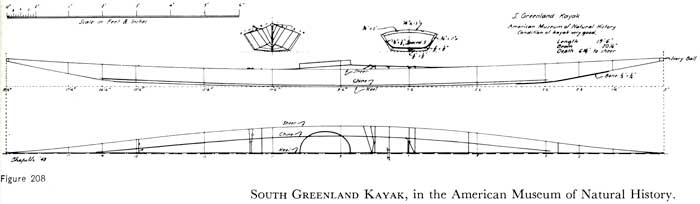
Njord ritades 2005 och är löst baserad på östgrönländska förlagor, främst den kajak som finns på the American Museum of Natural History (fig 208 i "the Bark Canoes and Skin Boats of North America") och som i boken felaktigt benämns "South Greenland Kayak". Black Pearl och Hunter är inspirerade av samma förlaga. Redan att välja stripbygge är en stor avvikelse – förlagan är naturligtvis ribb och skinn. Utöver det har jag höjt däcket för att skapa lastutrymme och lastkapacitet, vilken grönländska kajaker inte har.
Som framgår av bilderna finns inte mycket kvar av förlagans utseende. Jag hamnade i ett klassiskt dilemma: om jag behöll utseendet (som jag gjort på Black Pearl och Hunter) fick jag inte till de egenskaper jag sökte – och när jag var nöjd med egenskaperna var det inte mycket Grönland kvar i linjerna. Slutsatsen är kanske att den grönländska jaktkajaken inte är skalbar – försöken att öka fart och lastkapacitet innebär att man sköljer ut barnet med badvattnet. Nåja, eftersom jag redan hade min Black Pearl fick funktionen bli avgörande. Njord är därför en hybrid: manöverbarhet, komfort och rollbarhet från Grönland, fart från multisportkajaker och lastkapacitet från snabba havskajaker. "Ulv i fårakläder" var omdömet från en överraskad grönlandspaddlare, normalt paddlande sina egna ribb och duk-grönländare.
Den östgrönländska kajaken fick sin moderna form ganska sent jämfört med den västgrönländska, sedan östra Grönland blev avskuret från västkusten av bistert klimat under så kallade lilla istiden. Jämfört med de äldre typerna var den smalare, längre, hade flackare stävar och rakare relingslinje. Den hade planare botten och mera utfallande sidor. I praktiken var den snabbare, framför allt mot vinden och den manövrerade bättre. Initialstabiliteten var något lägre men slutstyvheten högre. Den krävde mer av paddlaren men hade också mer att ge. På östra Grönland levde jakt från kajak kvar ända till för några decennier sedan och traditionen är därför i högsta grad levande. Kring förra sekelskiftet började den påverka skrovformerna även längs den västra kusten. Mer om grönländsk kajakhistoria.
Kajaken är döpt efter Njord ("kraft", "styrka"), fornvästnordiska Njǫrðr, som var en av vanerna och havets, vädrets, rikedomens, handelns, sjöfartens och fiskets gud i nordisk mytologi, och far till Frej och Freja
För övrigt är bakgrunden ungefär densamma som för Black Pearl och Hunter.